Step 3 - Self Assessment
Make a list of your obsessions and related compulsions. It may be difficult to list things out, but listing it out will help make start making sense of it all and tackle it in a structured way.
An example below :
| Situation | Obsession | Compulsion |
| While making Wudu | Maybe I left out some part | Washing again and again until I feel I’ve done it enough |
| While praying | Maybe I did not recite Faitha in the right way | Reciting again and very slowly until I feel I’ve perfected it |
| Anytime | Scared of committing illegal sexual act | No |
| Anytime | What if I don’t really believe in Allah | Re-instating Shahada and saying Istighfar 100 times |
Once you’ve made a list, score the obsessions and compulsions as per their intensity. One way of doing os is to use SUDS (subjective Units of Distress Scale), which is a scale of 0 to 100 (or 0 to 10) for measuring the subjective intensity of disturbance or distress currently experienced by an individual. Below graphic explains SUDS (we suggest using 0-10 scale as per the graphic) :
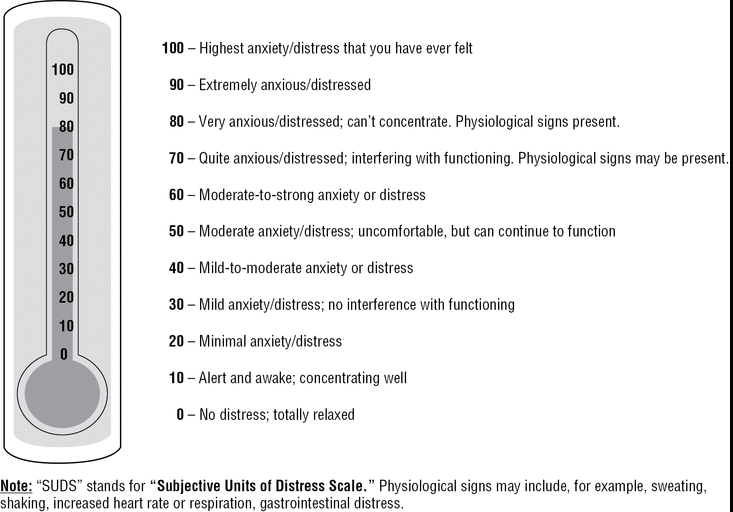
Source : Oxford Clinical Psych
Once you’ve evaluated your obsessions and compulsions using SUDS the table may looks like
| Situation | Obsession | Compulsion | SUDS |
| While making Wudu | Maybe I left out some part | Washing again and again until I feel I’ve done it enough | 10 |
| While praying | Maybe I did not recite Faitha in the right way | Reciting again and very slowly until I feel I’ve perfected it | 5 |
| Anytime | Scared of committing illegal sexual act | No | 4 |
| Anytime | What if I don’t really believe in Allah | Re-instating Shahada and saying Istighfar 100 times | 3 |